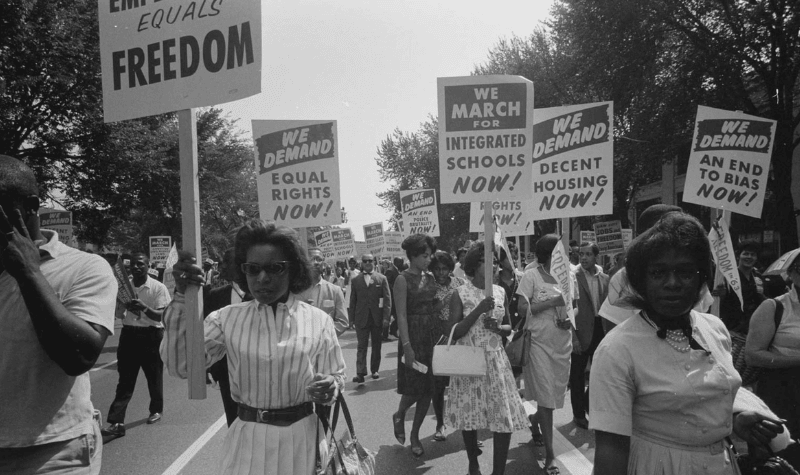

Black history is American history—but the version many of us grew up hearing in classrooms has often been trimmed down to a short highlight reel: slavery, a few “firsts,” the Civil Rights Movement, then a quick jump to the present. That’s not an accident. For generations, institutions shaped what was considered “worthy” of being taught, which stories were treated as footnotes, and which truths were too uncomfortable for mainstream curricula.
And the impact is measurable. In 2022, the National Assessment of Educational Progress (NAEP) reported that 8th-grade U.S. history scores declined compared with 2018 for several student groups, including Black students. That’s not just about test performance—it’s about who is being served by the history we choose to teach. Research on educational materials also finds persistent gaps in representation. A New America analysis summarizing textbook studies notes that African Americans appeared in only about 6–12% of textbook images in certain grade-level U.S. history texts—a mismatch with how foundational Black life and labor have been to this country.
This article is an evergreen, authority-style guide designed to expand the story. Not with myths. Not with social-media “fun facts” that fall apart under scrutiny. But with verified, sourced history—the kind that strengthens cultural memory, sharpens perspective, and reminds us that Black people have always been strategists, builders, organizers, innovators, and freedom-makers.
Why These Stories Get Left Out
From “Negro History Week” (1926) to Black History Month (1976)
Black communities have long understood that if we don’t preserve our own history, someone else will distort it—or erase it. In 1926, historian Carter G. Woodson helped launch Negro History Week to push back against the near-total exclusion of Black contributions from mainstream education. The movement expanded over time, and in 1976—on the 50th anniversary—President Gerald Ford issued a message recognizing Black History Month as a national observance, urging the country to honor accomplishments too often neglected (National Archives: Ford Library; Library of Congress overview).
Still, “recognition” doesn’t guarantee depth. Black history is frequently treated as a seasonal add-on instead of a year-round framework—despite the fact that Black people have shaped every major era of U.S. development: labor, politics, agriculture, war, science, art, law, religion, and global diplomacy.
25 Little-Known Black History Facts (Verified & Sourced)
Below are 25 under-taught facts, organized across eras. Each one includes specific years and a reputable source link you can verify yourself.
1) The Stono Rebellion (1739) was the largest uprising of enslaved people in the British mainland colonies before the American Revolution.
On September 9, 1739, enslaved Africans in South Carolina organized a rebellion now known as the Stono Rebellion. The Library of Congress describes it as the largest uprising of enslaved people in the British mainland colonies prior to the American Revolution (Library of Congress: Today in History). This matters because it challenges the lie that enslaved people were passive or accepted bondage—resistance was constant, strategic, and often organized at scale.
2) The Haitian Revolution (1791–1804) overthrew French rule and created an independent nation founded and governed by formerly enslaved people.
From 1791 to 1804, the Haitian Revolution resulted in the establishment of an independent country created by people who had been enslaved under the French regime (Encyclopaedia Britannica). Haiti’s independence in 1804 shook the Atlantic world and reshaped global conversations about slavery, freedom, and Black political power.
3) The 1811 German Coast Uprising involved hundreds of enslaved people—one of the largest slave rebellions in U.S. history.
On the night of January 8, 1811, hundreds of enslaved people rose up in Louisiana in what Smithsonian Magazine describes as one of the largest slave rebellions in U.S. history, with reports noting more than 500 participants taking up arms (Smithsonian Magazine). The scale of this uprising is rarely taught, but it belongs in any honest telling of early America.
4) In 1821, Thomas L. Jennings became the first African American to receive a U.S. patent—helping pioneer “dry scouring,” a precursor to dry cleaning.
In 1821, Thomas Jennings patented a method for cleaning clothing known as “dry scouring,” often described as a foundation for modern dry cleaning (Smithsonian Magazine). Black innovation has always been here—even in industries people treat as “ordinary.”
5) Freedom’s Journal (1827–1829) was the first African American newspaper in the United States.
Freedom’s Journal, published in New York from 1827 to 1829, is documented by the Library of Congress as the first African American newspaper in the United States (Library of Congress: Freedom’s Journal). This is an early reminder that Black people built our own media institutions to tell our stories when mainstream outlets wouldn’t.
6) Frederick Douglass’s newspaper The North Star began publishing in 1847 with an explicit mission to uplift Black people intellectually and morally.
The Library of Congress notes that in the December 3, 1847 issue of The North Star, one stated object was to “promote the moral and intellectual improvement of the colored people” (Library of Congress: Douglass Newspapers). Black media has always been about power: narrative power, political power, cultural power.
7) Harriet E. Wilson’s novel Our Nig was published in 1859—and the Library of Congress preserves it as a primary source.
Our Nig, published in 1859, is preserved in the Library of Congress collection (Library of Congress item record). Black women’s authorship and literary labor existed well before many school reading lists begin acknowledging us.
8) Robert Smalls seized a Confederate ship in 1862 and delivered it to the U.S. Navy—then later served in Congress.
On May 13, 1862, Robert Smalls and a Black crew commandeered the Confederate ship Planter and delivered it to the United States Navy—an act documented by the U.S. House of Representatives historical collection (History, Art & Archives, U.S. House) and explored by the National Archives’ “Pieces of History” blog (National Archives). Smalls’s story belongs in every conversation about courage, military intelligence, and political leadership.
9) The Combahee River Raid (June 1–2, 1863) helped liberate enslaved people in South Carolina and involved Harriet Tubman.
The National Park Service documents that the Combahee River raid occurred on June 1–2, 1863 and aimed to destroy plantation infrastructure and liberate enslaved laborers (NPS: “We Called Ourselves Combee”). The National Museum of African American History and Culture (NMAAHC) also highlights Tubman’s role in the raid (NMAAHC story).
10) During Reconstruction, historians estimate that as many as 2,000 Black men held public office in the South—including 16 in Congress.
Many people learn Reconstruction as a “failed experiment.” But the reality is more powerful: Black political participation surged. Historians estimate as many as 2,000 Black men held office in southern states during Reconstruction, including 16 members of Congress (WhoBuiltAmerica.org). That number represents governance, policy influence, and community protection—until white supremacist violence and laws attempted to reverse it.
11) Hiram Rhodes Revels became the first African American to serve in the U.S. Senate in 1870.
In 1870, Hiram Rhodes Revels became the first African American to serve in the U.S. Senate (U.S. Senate historical briefing). Too often, Reconstruction leadership gets minimized. It shouldn’t.
12) The National Association of Colored Women’s Clubs (NACWC) formed in 1896 as a national umbrella for Black women’s organizing.
The National Association of Colored Women’s Clubs was established in July 1896 as a merger of organizations—creating a national umbrella for Black women’s civic work (VCU Social Welfare History Project). Black women’s organizing has always been central infrastructure, not a side story.
13) The Wilmington Coup of 1898 overthrew a democratically elected, multi-racial government in North Carolina.
On November 10, 1898, a white mob seized control of the local government in Wilmington, North Carolina—destroying a Black-owned newspaper and terrorizing the Black community. North Carolina’s Department of Natural and Cultural Resources describes it as a turning point that accelerated statewide disenfranchisement and Jim Crow restrictions (NC DNCR). The National Endowment for the Humanities also describes Wilmington as the first successful coup d’état in U.S. history (NEH).
14) Boley, Oklahoma was founded in 1903 and became one of the most well-known all-Black towns in the U.S.
Boley was founded in 1903 and incorporated in 1905. The Oklahoma Historical Society describes it as the largest and most well-known of the state’s all-Black towns and notes that more than fifty all-Black towns existed in Oklahoma historically (Oklahoma Historical Society encyclopedia entry).
15) The Niagara Movement began in 1905—and in 1906 held its first public meeting in the U.S. at Storer College in Harpers Ferry.
The National Park Service notes that the Niagara Movement held its first public meeting in the United States from August 15–19, 1906 at Storer College in Harpers Ferry, West Virginia—building momentum for direct civil rights demands (NPS: Niagara Movement). The movement helped shape the civil rights strategies that followed.
16) The True Reformers Bank, founded in 1889, is cited by the Library of Congress as an early model of Black financial institution-building.
In 1889, the True Reformers Bank was founded by Rev. William Washington Browne. The Library of Congress highlights its significance and influence as a model for later Black financial institutions (Library of Congress blog: True Reformers). When people ask “why do we need Black-owned banks?” this history answers: because exclusion created necessity—and necessity created innovation.
Internal-linking opportunity (Melaviews): This is a perfect spot to link an evergreen finance article using anchor text like “how Black-owned banks helped build community wealth”.
17) Roughly one in four cowboys after the Civil War were Black, according to historians cited by Smithsonian Magazine.
The “Wild West” story is often whitewashed. Smithsonian Magazine notes that historians estimate one in four cowboys were Black—even though popular narratives rarely show it (Smithsonian Magazine).
18) The Great Migration (roughly 1910s–1970s) involved about six million Black people moving out of the South.
The National Archives describes the Great Migration as one of the largest movements of people in U.S. history, noting that approximately six million Black people moved from the South to Northern, Midwestern, and Western states roughly from the 1910s until the 1970s (National Archives: Great Migration). The Census Bureau also visualizes this as an estimated 6 million leaving the South between 1910 and 1970 (U.S. Census Bureau visualization).
19) The Brotherhood of Sleeping Car Porters was founded in 1925 and became the first Black-led union to receive an AFL charter.
The Library of Congress notes the Brotherhood of Sleeping Car Porters was founded on August 25, 1925 and was the first African American–led labor organization to receive a charter in the American Federation of Labor (Library of Congress guide). This is crucial labor history—and crucial Black economic history.
20) Marian Anderson’s 1939 Lincoln Memorial concert became a defining moment after she was barred from Constitution Hall.
On April 9, 1939, Marian Anderson performed at the Lincoln Memorial in a concert arranged after she was denied a venue due to racism. The National Archives preserves and contextualizes this event as a key moment in cultural and civil rights history (National Archives blog; National Archives: Pieces of History).
21) The federal government officially recognized Black History Month in 1976—after decades of Black-led organizing and education work.
In a message dated February 10, 1976, President Gerald Ford recognized Black History Month—an event documented by the National Archives as the first presidential recognition of Black History Month as such (National Archives: Ford in Focus). This recognition came from Black intellectual and community organizing—long before it became mainstream.
22) The FBI’s COINTELPRO began in 1956 and ended in 1971—and expanded in the 1960s to target groups including the Black Panther Party.
The FBI’s own “Vault” archive states that COINTELPRO began in 1956 and was ended in 1971, and that in the 1960s it expanded to include domestic groups such as the Ku Klux Klan and the Black Panther Party (FBI Records: The Vault). Understanding state surveillance is part of understanding Black political history.
23) Shirley Chisholm was elected to Congress in 1968 and ran for the Democratic presidential nomination in 1972.
Shirley Chisholm was first elected in 1968 and launched a campaign for the Democratic presidential nomination in 1972, according to the official U.S. House of Representatives history pages (History, Art & Archives, U.S. House; House Historical Highlight). She wasn’t just “a first”—she was a blueprint.
24) The only all-Black, all-female unit deployed overseas in WWII—the “Six Triple Eight”—handled an enormous mail backlog that kept morale alive.
The 6888th Central Postal Directory Battalion (often called the “Six Triple Eight”) is widely documented as the only all-Black women unit deployed overseas during World War II. Their work mattered because mail was emotional infrastructure—connection, hope, morale. (For a strong primary institutional entry point, see the U.S. Army’s historical features and documentation on the 6888th: U.S. Army feature hub.)
25) In 1951, Henrietta Lacks’s cells became the first “immortal” human cell line used widely in research—without her consent.
The NIH notes that in 1951, Henrietta Lacks went to Johns Hopkins for cervical cancer treatment and cells from her tumor began being used for research—later known as “HeLa” cells (NIH Office of Science Policy). This is not only medical history; it’s a reminder that ethics and Black bodily autonomy have long been contested terrain.
What These 25 Facts Reveal (The Bigger Pattern)
1) Black resistance wasn’t rare—it was normal.
From 1739 (Stono) to 1811 (German Coast) to international revolution (Haiti), we see a consistent throughline: Black people were never waiting to be “saved.” We were resisting, planning, and moving.
2) Black institutions are not “extras”—they’re survival infrastructure.
Freedom’s Journal (1827), The North Star (1847), the True Reformers Bank (1889), the NACWC (1896), and Black towns like Boley (1903) show that Black communities built parallel systems when America denied us access.
3) Backlash is part of the story, too.
The Wilmington Coup (1898) is a sobering reminder that when Black communities gain political and economic power, there have often been organized attempts to dismantle it—by force, by law, and by propaganda.
How to Use This Article (Beyond Reading)
Build a personal “Black history syllabus”
- Choose one fact per week.
- Read a primary source (many are linked above via the Library of Congress and National Archives).
- Discuss it with your family—especially youth.
Turn learning into legacy
- Save these links.
- Start a “family archive” note with timelines (years, places, names).
- Record elders’ stories alongside the public record—your family history is Black history, too.
Share strategically (not just socially)
Instead of only posting facts as captions, link them to action:
- Support a Black newspaper or newsroom.
- Open an account at a Black-owned financial institution if one exists in your region.
- Donate to a local Black history museum or archival project.
Conclusion: The Story Gets Bigger When We Tell the Truth
What you were taught in school was never the full story. And once you see what’s missing—mass uprisings, nation-building, institution-building, economic strategy, political leadership, labor organizing, cultural breakthroughs—you can’t unsee it.
These 25 facts aren’t random trivia. They are evidence of a people who have always been dynamic, determined, and brilliantly human—despite the nation’s repeated attempts to narrow our story into a single chapter.
Call to action: Pick three facts from this article and share them with intention—send them to a family group chat, discuss them with your kids, or use them to start a community conversation. And if you’re building something—business, media, policy, art—build it with the confidence that you come from a long line of builders.