Country music is often packaged as a distinctly white, rural Southern genre. But that narrative collapses under historical scrutiny. The instruments, vocal stylings, storytelling traditions, and rhythmic foundations of country music are deeply intertwined with Black musical heritage.
The banjo — one of country music’s most recognizable instruments — traces its lineage to West African instruments such as the akonting, brought to the Americas during the transatlantic slave trade. The Library of Congress documents the banjo’s evolution from West African prototypes into a staple of American folk and country traditions during the 18th and 19th centuries.
Yet despite these roots, Black artists have historically been underrepresented in country radio and award circuits. A 2021 study by the University of Ottawa found that Black artists accounted for just 1.5% of country radio airplay between 2002 and 2020, according to coverage by Rolling Stone. That disparity isn’t about talent — it’s about gatekeeping.
This comprehensive guide explores the top Black country artists you should know — spanning the pioneers who helped shape the genre’s foundation, the barrier-breakers of the late 20th century, and the present-day artists redefining what country looks and sounds like. Understanding their contributions is not revisionist history. It is corrective history.
The African Foundations of Country Music (1700s–1800s)
Before the term “country music” even existed, enslaved Africans in the American South were shaping the musical DNA that would later define American folk and country traditions.
The Smithsonian National Museum of American History notes that early banjos were constructed by enslaved Africans in the Caribbean and American South using gourds, animal skins, and wooden necks. These instruments directly influenced early Appalachian music.
During the 18th and 19th centuries, Black and white musicians frequently exchanged musical ideas in rural communities. Fiddle tunes, spirituals, work songs, and ballads cross-pollinated. The line between “Black music” and “white music” was far more fluid than later industry categories would suggest.
It wasn’t until the early 20th century — when record companies began marketing “race records” to Black audiences and “hillbilly records” to white audiences — that artificial racial segmentation hardened the genre lines.
Early Pioneers: Black Artists at Country Music’s Commercial Birth (1920s–1940s)
DeFord Bailey (1899–1982)
When the Grand Ole Opry began broadcasting nationally in 1925, DeFord Bailey became one of its earliest stars. He joined the Opry in 1927 and was widely celebrated for his harmonica skills. The Country Music Hall of Fame confirms that Bailey was among the first performers to popularize harmonica instrumentals in country broadcasting.
Despite his talent and popularity, Bailey faced discrimination and was eventually dismissed from the Opry in the 1940s. Decades later, in 2005, he was posthumously inducted into the Country Music Hall of Fame — an overdue acknowledgment of his foundational role.
Lesley Riddle (1905–1980)
Lesley Riddle collaborated with A.P. Carter of the Carter Family during song-collecting trips in the late 1920s. According to the Country Music Hall of Fame, Riddle helped preserve and adapt songs that became staples of early country repertoire.
Riddle’s contributions illustrate how Black musicians were not just performers — they were archivists and cultural transmitters.
Mid-20th Century Barrier Breakers (1950s–1980s)
Charley Pride (1934–2020)
Charley Pride stands as one of the most commercially successful country artists of all time — regardless of race. He achieved 29 No. 1 hits on Billboard’s Hot Country Songs chart and sold millions of records.
The Country Music Hall of Fame confirms his induction in 2000. In 1971, Pride won the Country Music Association’s Entertainer of the Year award — one of the genre’s highest honors.
Pride performed during an era when segregation still shaped American life. His success challenged industry assumptions and audience biases, forcing country music to confront its own racial boundaries.
Linda Martell
In 1969, Linda Martell became the first Black woman to perform at the Grand Ole Opry. According to NPR, Martell faced overt racism from audiences and industry insiders despite chart success.
Her career was cut short by discrimination, but her legacy has gained renewed recognition in recent years.
The 1990s–2000s: Slow Progress & New Visibility
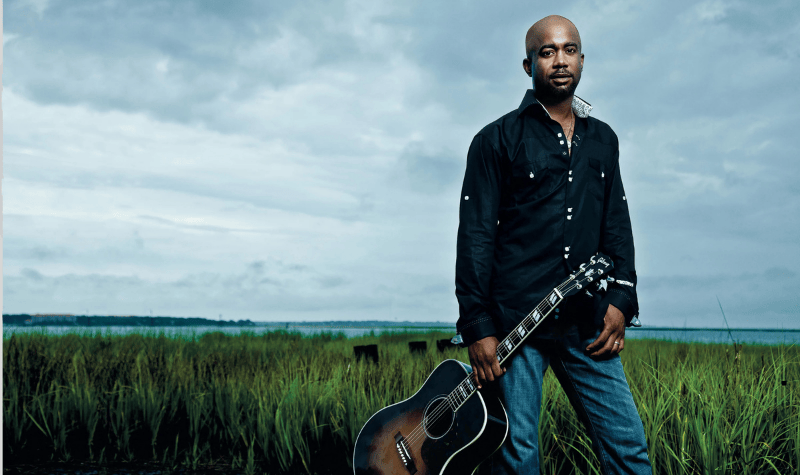
Darius Rucker
After fronting Hootie & the Blowfish, Darius Rucker transitioned to country music in 2008. His single “Don’t Think I Don’t Think About It” reached No. 1, making him the first Black solo artist since Charley Pride to top the country charts, according to Billboard.
In 2009, he won the CMA Award for New Artist of the Year.
Rissi Palmer
Rissi Palmer’s 2007 single “Country Girl” charted on Billboard, marking a rare moment for Black women in the genre. She later launched Color Me Country Radio to spotlight artists of color in country music.
The Contemporary Era: Reclaiming and Redefining (2010s–Present)
Mickey Guyton
In 2021, Mickey Guyton became the first Black woman nominated for a Grammy Award in a country category for “Black Like Me” (Grammy.com). The song directly addressed racial identity within country spaces.
Kane Brown
Kane Brown made history in 2017 when he became the first artist to top all five main Billboard country charts simultaneously (Billboard).
Jimmie Allen
Jimmie Allen’s debut single “Best Shot” reached No. 1 in 2018, making him the first Black artist to launch with a No. 1 debut on the Country Airplay chart (Billboard).
Brittney Spencer
Brittney Spencer has earned critical acclaim for merging traditional country vocal stylings with modern narratives.
Shaboozey
Shaboozey blends country aesthetics with hip-hop and trap production, signaling genre expansion.
The Economic and Cultural Stakes
Country music remains one of the most commercially powerful genres in the United States. According to the Recording Industry Association of America (RIAA), country consistently ranks among the top-selling genres annually (RIAA Sales Database).
When Black artists are excluded from mainstream airplay, it affects touring revenue, publishing income, and long-term generational wealth.
The Future of Black Country Music
The future includes hybrid sounds blending country instrumentation with Afrobeats, trap drums, R&B vocals, and gospel harmonies. Streaming platforms have reduced some gatekeeping barriers, allowing audiences to discover artists outside traditional radio pipelines.
The genre’s future will likely reflect America’s changing demographics. According to the U.S. Census Bureau, the nation continues to grow more racially diverse. Cultural genres inevitably follow demographic shifts.
Conclusion: Rewriting the Narrative
Black country artists are not guests in the genre — they are architects. From DeFord Bailey’s 1927 Opry performances to Mickey Guyton’s Grammy nominations nearly a century later, the thread of influence is undeniable.
The next time someone frames country music as racially exclusive, remember the banjo’s West African origins, Charley Pride’s 29 No. 1 hits, and the countless artists building new pathways today.
Call to Action: Create a playlist featuring at least five Black country artists from different eras. Stream their music. Attend their shows. Support independent Black country radio initiatives. Cultural memory grows when we intentionally amplify it.