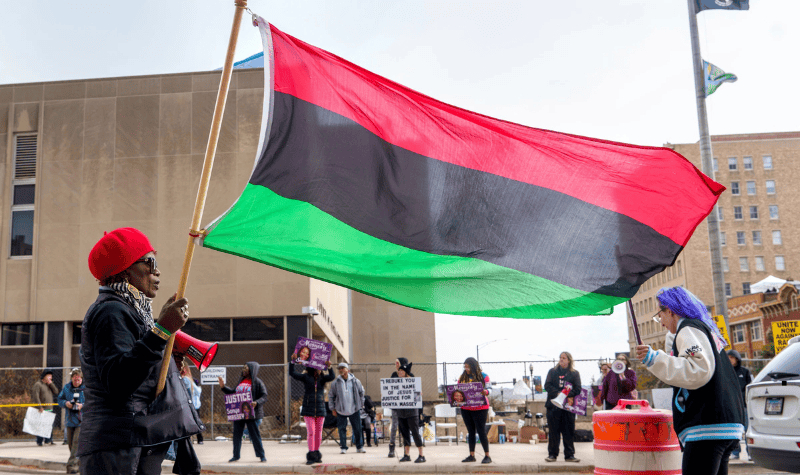

Every February, schools, churches, corporations, and community organizations across the United States raise banners, decorate bulletin boards, and redesign logos in red, black, and green. Social media feeds fill with Pan-African colors. But one question quietly surfaces every year: Is there an official Black History Month flag?
The short answer: No, there is no federally recognized or officially designated Black History Month flag. However, several historic flags — particularly the Pan-African flag — are widely used during Black History Month because of their deep cultural and political significance.
To understand why there isn’t a single “official” flag — and why certain flags are commonly displayed in February — we need to explore the history of Black History Month, the origins of the Pan-African flag, and the broader symbolism behind Black cultural identity.
The Origins of Black History Month (1926–Present)
Black History Month did not begin as a government-created observance. It started as Negro History Week in 1926, founded by historian Carter G. Woodson and the Association for the Study of Negro Life and History.
Woodson chose the second week of February to coincide with the birthdays of Abraham Lincoln (February 12) and Frederick Douglass (celebrated February 14).
According to the Library of Congress, Negro History Week expanded into Black History Month by the late 1960s and was officially recognized by the federal government in 1976 during the U.S. Bicentennial, when President Gerald Ford urged Americans to “seize the opportunity to honor the too-often neglected accomplishments of Black Americans.”
Notably, this recognition did not establish an official flag, logo, or standardized visual symbol.
Is There an Official Black History Month Flag?
No federal agency, including Congress or the White House, has designated an official Black History Month flag. Unlike the U.S. flag or individual state flags, Black History Month does not have a legally codified emblem.
The U.S. Code (Title 4) governs official flags and their display protocols. Black History Month is recognized as a commemorative observance, but no legislation establishes a specific flag design.
So why do so many spaces use red, black, and green during February?
The Pan-African Flag: The Most Commonly Displayed Symbol
The flag most often associated with Black History Month is the Pan-African flag, also known as the UNIA flag.
Origins of the Pan-African Flag (1920)
The Pan-African flag was created in 1920 by members of the Universal Negro Improvement Association (UNIA), founded by Marcus Garvey.
At the UNIA convention in New York City in August 1920, the organization adopted the red, black, and green tricolor flag as a symbol of Black pride and global unity.
The NAACP and other historians note that the flag was partly a response to a popular 1900 song titled “Every Race Has a Flag But the Coon,” which mocked Black Americans for lacking a national symbol. The UNIA sought to correct that insult with a unified banner.
Meaning of the Colors
- Red – The blood that unites all people of African descent and shed in the struggle for liberation.
- Black – The people themselves.
- Green – The rich land of Africa.
Because Black History Month celebrates the global African diaspora, the Pan-African flag naturally became the most visible symbol during February observances — even though it is not an official government emblem.
The Black American Heritage Flag (1967)
Another flag sometimes displayed during Black History Month is the Black American Heritage Flag, created in 1967 by Melvin Charles and Gleason T. Jackson.
This flag also uses red, black, and green but includes a central emblem featuring a sword and wreath. It was designed specifically to represent African Americans in the United States.
While respected, it has not achieved the same widespread recognition as the Pan-African flag.
Why There Is No Single Official Flag
There are several reasons Black History Month does not have an official flag:
1. It Is a Cultural Observance, Not a Sovereign Nation
Flags are traditionally associated with nations or states. Black History Month is a commemorative observance recognizing contributions and history — not a political entity.
2. The African Diaspora Is Diverse
Black identity spans continents: Africa, the Caribbean, Latin America, Europe, and North America. No single symbol can encapsulate that global diversity.
3. Grassroots Origins
Because Black History Month emerged from grassroots scholarship rather than federal mandate, its symbolism developed organically.
How Flags Are Used During Black History Month Today
In modern observances, the Pan-African flag is commonly:
- Displayed in schools and universities
- Raised outside city halls
- Featured in corporate diversity campaigns
- Used in community parades and festivals
In 2020 and 2021, multiple U.S. cities raised the Pan-African flag during Juneteenth celebrations as well, further expanding its public visibility.
Black History Month vs. Juneteenth Symbols
It’s important to distinguish between Black History Month and Juneteenth symbols.
The Juneteenth flag, created in 1997 by activist Ben Haith, features a bursting star and arc design. It specifically commemorates June 19, 1865 — the date enslaved people in Texas learned of emancipation.
While often displayed during Black History Month events, the Juneteenth flag represents a distinct historical milestone.
The Economic & Cultural Significance of Symbolism
Symbols drive identity and economic activity. According to Nielsen’s research on multicultural consumers, culturally relevant representation increases brand loyalty and consumer engagement.
When corporations display Pan-African colors during February, they are acknowledging both cultural heritage and economic power.
However, symbolism without substance can ring hollow. True engagement requires educational investment, policy support, and year-round recognition.
What You Should Know Before Displaying a Flag
If you plan to display a flag during Black History Month:
- Understand its origin.
- Know the meaning of the colors.
- Recognize that it represents global solidarity, not government endorsement.
- Use it respectfully and intentionally.
Conclusion: A Month, Many Symbols
So, is there an official Black History Month flag? No. But the widespread use of the Pan-African flag reflects a century-old movement for unity and pride.
Black History Month is about more than colors — it is about memory, resilience, achievement, and forward momentum.
Call to Action: This February, don’t just display a flag. Learn its history. Teach its meaning. And pair symbolism with action — support Black-owned institutions, read Black historians, and invest in the communities the colors represent.