
Introduction: More Than a Tragedy — A Blueprint of Black Excellence
When people hear “Black Wall Street,” they often think first of destruction. They picture flames. Smoke. Ruins. They recall the Tulsa Race Massacre of May 31–June 1, 1921.
But before there was smoke, there was wealth. Before there was destruction, there was discipline. Before there was tragedy, there was one of the most economically advanced Black communities in American history.
The Greenwood District of Tulsa, Oklahoma—later known as Black Wall Street—was a thriving, self-sustaining Black economic powerhouse in the early 20th century. By 1921, it spanned more than 35 square blocks and housed hundreds of Black-owned businesses, luxury homes, professional offices, schools, and churches. It was not symbolic success. It was measurable success.
This is the story of how it was built, why it was targeted, how it was destroyed, and what its legacy means today—especially in conversations about ownership, economic independence, and the racial wealth gap.
The Rise of Greenwood: How Black Wall Street Was Built (1900–1921)
Tulsa’s Oil Boom and Black Migration
Tulsa was incorporated in 1898 and quickly transformed into an oil capital after major discoveries in the early 1900s. The region experienced explosive economic growth. But Oklahoma also held another distinction: it had more all-Black towns than any other state in the U.S. Between 1865 and 1920, more than 50 all-Black towns were established there.
Many Black Americans migrated to Oklahoma during Reconstruction and the early 20th century seeking land ownership, opportunity, and relative autonomy from Southern racial terror. While Oklahoma was not free of racism—it was admitted as a segregated state in 1907—it still presented more economic opportunity than much of the Deep South.
In Tulsa, segregation ironically created concentrated Black economic development. Because Black residents were barred from white businesses and neighborhoods, they built their own.
O.W. Gurley and the Foundation of Greenwood
O.W. Gurley, a wealthy Black landowner from Arkansas, purchased 40 acres of land in Tulsa in 1906. His vision was clear: create a community where Black people could own land, start businesses, and build generational wealth.
Gurley sold parcels of land exclusively to Black residents and entrepreneurs. Alongside him were other prominent Black businessmen, including J.B. Stradford, who built the Stradford Hotel—one of the largest Black-owned hotels in the United States at the time.
Greenwood Avenue became the spine of Black Tulsa’s economy. What emerged was not accidental growth. It was intentional economic engineering.
Economic Power and Infrastructure
By 1921, Greenwood was one of the most prosperous Black communities in America.
- Approximately 35 square blocks
- More than 1,000 Black-owned homes
- Over 600 Black-owned businesses
- Two newspapers
- A hospital
- A public library branch
- Schools, churches, hotels, theaters, and professional offices
The term “Black Wall Street” is often attributed to Booker T. Washington, who visited Tulsa in 1913 and praised Greenwood’s economic progress. Whether formally coined during his visit or later popularized, the name stuck because it was accurate.
The Circulation of the Black Dollar
While exact data on dollar circulation in Greenwood is limited, scholars note that segregated communities often saw high levels of internal economic recirculation because residents were forced to buy within their own community.
Black professionals served Black clients. Black grocers sold to Black families. Black banks lent to Black homeowners. Teachers educated Black children. This internal ecosystem created jobs, equity, and stability.
Greenwood demonstrated something America rarely acknowledged: when allowed access to land and capital, Black communities could build at scale.
The Spark: May 30, 1921
The destruction of Greenwood did not begin with a random mob. It began with an allegation.
On May 30, 1921, Dick Rowland, a 19-year-old Black shoe shiner, entered an elevator operated by Sarah Page, a 17-year-old white woman. What happened inside the elevator remains disputed. The most commonly cited explanation is that Rowland may have stumbled and grabbed Page’s arm to steady himself.
The next day, a local newspaper published a sensationalized article suggesting Rowland had assaulted Page. Headlines inflamed white residents. Rumors of a lynching began to circulate.
Black World War I veterans, aware of the lynching culture spreading across America during the Red Summer period (1919–1923), went to the courthouse to protect Rowland. A confrontation between armed Black veterans and white residents escalated into violence.
Within hours, white mobs began assembling.
The Tulsa Race Massacre (May 31–June 1, 1921)
A Coordinated Assault
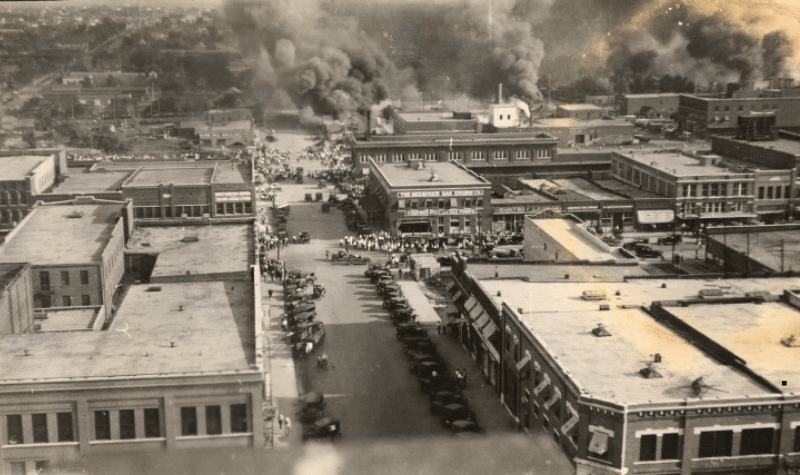
In the early hours of May 31, white mobs crossed the railroad tracks separating white Tulsa from Greenwood. Witness accounts and later investigations describe looting, arson, and shootings.
The 2001 Oklahoma Commission Report confirmed that airplanes were seen flying over Greenwood during the attack. Some eyewitnesses reported incendiary devices being dropped, though historians continue to debate the scale of aerial involvement.
The Oklahoma National Guard eventually declared martial law—but not before much of Greenwood had already been destroyed.
The Human Toll
For decades, official death counts minimized the tragedy. Early reports claimed 36 fatalities. But modern research suggests the number was far higher.
The 2001 Oklahoma Commission estimated that between 100 and 300 Black residents were killed. More than 10,000 Black residents were left homeless.
Mass graves are still being investigated more than 100 years later.
In less than 24 hours, 35 square blocks were burned to the ground.
The Economic Devastation
Property damage was estimated at $1.5 to $2 million in 1921 dollars. Adjusted for inflation, that figure would equal tens of millions today—though many economists argue that when accounting for lost generational wealth, the true cost would be in the hundreds of millions, if not billions.
Insurance companies refused to pay claims, citing riot clauses. No white residents were convicted for the destruction.
This was not only violence. It was economic erasure.
The Cover-Up: Erasure and Silence (1921–1990s)
After the massacre, city leaders worked to suppress the story.
Newspaper archives disappeared. Official records were lost or destroyed. The event was omitted from school curricula for decades.
Survivors were intimidated into silence.
It was not until 1997 that Oklahoma established the Tulsa Race Riot Commission to formally investigate the massacre. In 2001, the Commission released a comprehensive report confirming the scale of destruction and recommending reparations.
For nearly 80 years, one of the largest acts of racial violence in American history was largely hidden from mainstream national memory.
Rebuilding Against the Odds
Despite devastation, Greenwood residents rebuilt.
By 1922, dozens of businesses were operating again. By the late 1920s and 1930s, Greenwood had regained significant commercial activity.
Black residents refused to abandon their land. They rebuilt brick by brick, business by business.
However, mid-20th-century urban renewal projects and highway construction—common across Black America—further disrupted the district in the 1960s and 1970s.
The rebuilding showed resilience. But the long-term wealth trajectory was permanently altered.
The Long-Term Economic Consequences
Generational Wealth Lost
Wealth compounds over time. Businesses expand. Real estate appreciates. Assets are inherited.
When Greenwood was destroyed, it was not just buildings that burned. It was compounded opportunity.
Imagine if 600 businesses had grown uninterrupted for 100 years. Imagine if commercial real estate values had appreciated across generations. Imagine if families had passed down thriving enterprises rather than starting from scratch.
The racial wealth gap remains stark. According to the 2019 Federal Reserve Survey of Consumer Finances, the median wealth of white families was nearly eight times that of Black families.
While Black Wall Street alone did not create the wealth gap, its destruction symbolizes how Black wealth accumulation has repeatedly been disrupted.
No Reparations, No Accountability
The 2001 Commission recommended direct payments to survivors and descendants, scholarships, and economic development initiatives.
To date, no comprehensive reparations have been implemented at the state or federal level.
As of the 100-year anniversary in 2021, only a handful of verified survivors were still living. Lawsuits seeking reparations have faced legal hurdles.
The absence of restitution reinforces a broader national pattern: economic harm inflicted on Black communities has rarely been financially repaired.
Modern Recognition and Renewed Attention
The centennial in 2021 brought renewed national attention. Mass grave investigations began. Academic research expanded. Public conversations intensified.
Tulsa now hosts memorials and educational centers dedicated to preserving the history of Greenwood.
But recognition and restoration are not the same.
The deeper question remains: what does Black Wall Street teach us about economic strategy today?
Lessons from Black Wall Street for Today
1. Ownership Is the Foundation
Greenwood thrived because Black residents owned land, buildings, and businesses. Ownership created leverage. It created employment. It created community stability.
Representation without ownership is visibility without control.
2. Economic Circulation Builds Strength
When dollars circulate within a community, institutions strengthen. Jobs multiply. Skills develop. Greenwood demonstrated the multiplier effect of internal economic support.
3. Wealth Must Be Protected
Greenwood’s destruction reveals a hard truth: economic progress without political and institutional protection is vulnerable.
Legal infrastructure, insurance protection, media control, and political representation matter alongside entrepreneurship.
4. Narrative Control Matters
For decades, the massacre was minimized or erased. Controlling narrative shapes public policy, education, and collective memory.
Greenwood’s story resurfaced because scholars, journalists, and descendants refused to let it disappear.
Conclusion: Greenwood’s Legacy Is Still Being Written
Black Wall Street was not a myth. It was documented prosperity.
It was proof that Black economic excellence was possible even within a segregated system. It was proof that ownership changes outcomes. It was proof that community investment compounds.
It was also proof that progress can be targeted.
But perhaps the most powerful part of the story is not the destruction—it is the fact that Greenwood existed at all.
The rise of Black Wall Street reminds us that economic self-determination is not new. It has precedent. It has history. It has receipts.
The question is not whether Black prosperity is possible.
The question is how it is built—and how it is protected—this time.